Al(tru)gorithm
An exploration of emergent altruism through autonomous robots.
- year
- 2026
- role
- artist, engineer
The idea grew out of an earlier robotics project on autonomous exploration. While working on navigation, I became interested in the moments when the robots looked less like machines and more like small insects. They would get stuck, sense one another, and help each other continue moving. That observation eventually became the project itself.
One of the visual decisions was to style the robots as small glowing fireflies. While developing the simulation, I found myself becoming unexpectedly attached to them. Watching them wander aimlessly, become trapped, and occasionally help one another made them feel less like autonomous agents and more like living creatures. The soft glow reinforces that impression, encouraging the viewer to empathize with systems that are nothing more than simple algorithms following a handful of rules.
The simulation is intended as a prototype for a future physical installation. Building a swarm of more than thirty identical robots is technically feasible, but it would require additional time and funding.
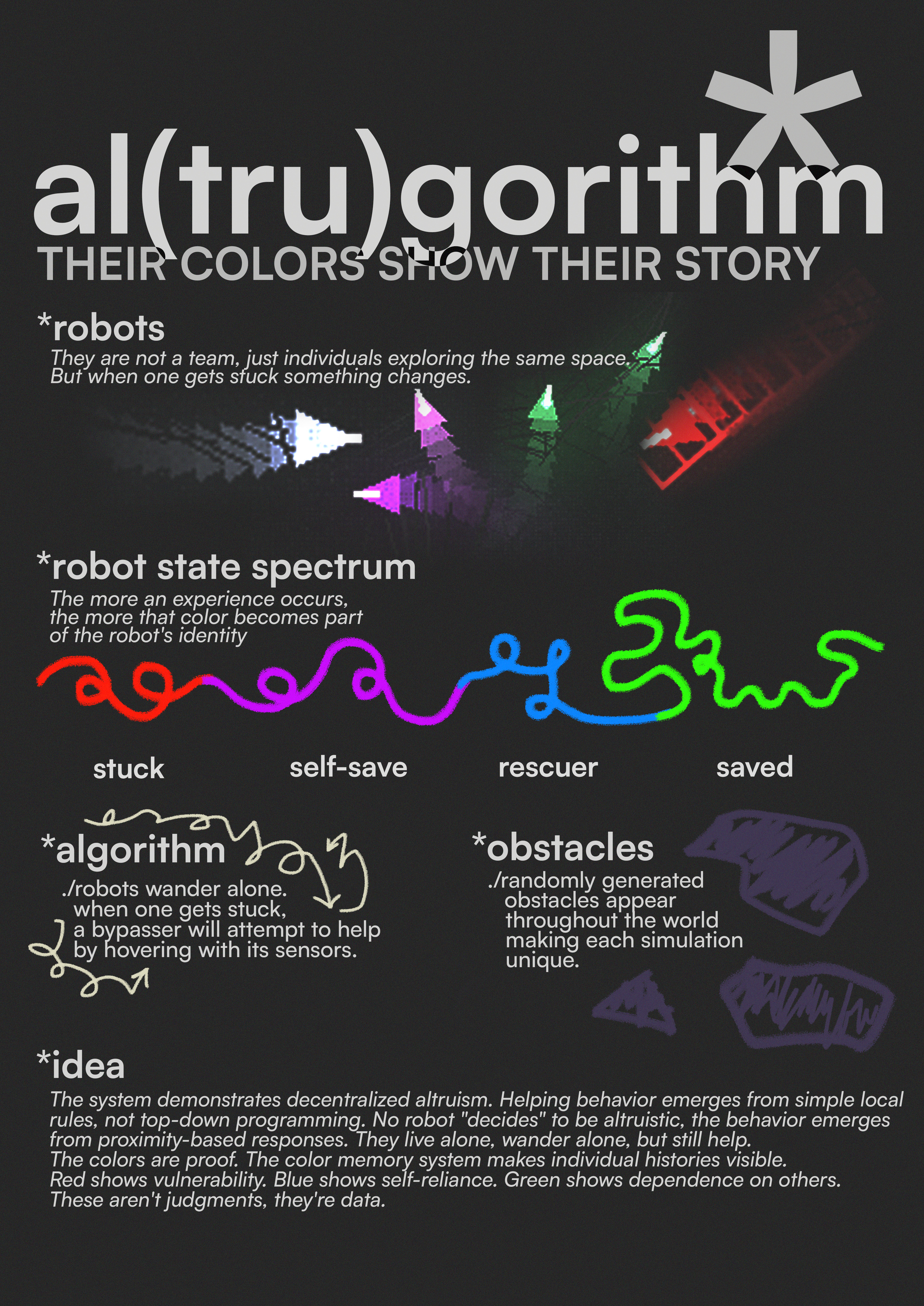
Rescue behavior
A rescue is determined by how the stuck robot starts moving again.
- If its front sensors continuously detect the assisting robot while it resumes moving, the rescue is considered successful and the robot briefly turns green.
- If it begins moving without another robot guiding it, it is considered a self-rescue and briefly turns purple.
Both colors gradually fade back to the robot’s base color after a few seconds.
Color memory
Each robot carries a persistent color that reflects its history.
- Frequently getting stuck increases the red component.
- Frequently escaping on its own increases the blue component.
- Frequently being rescued by others increases the green component.
Over time, every robot develops a unique visual record of its experiences. They explore alone, but they help when it is needed. Their colors become evidence of those interactions.
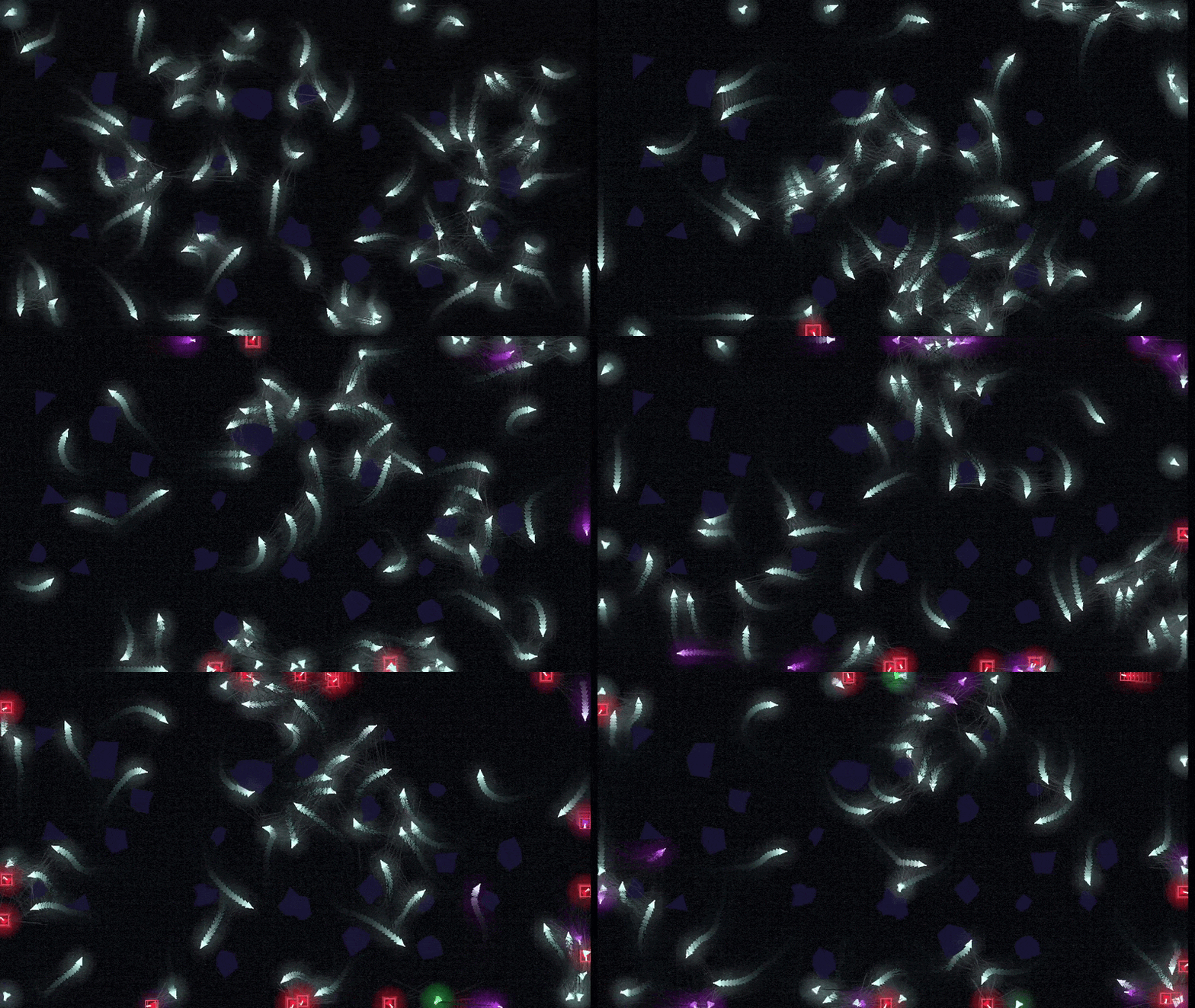
The project asks how little is needed before we begin to recognize social behavior. None of the robots understands what another robot is doing. They do not cooperate because they want to, and they have no concept of helping. The rescue behavior is simply another rule in the system. Yet when many robots follow the same rules, those interactions begin to resemble compassion, hesitation, and trust. The meaning exists almost entirely in the eyes of the observer.
Their colors reinforce this illusion. Each robot gradually accumulates a visible history of failure, independence, and assistance. The colors are not rewards or emotions. They are memory made visible, allowing every robot to carry the traces of its past interactions. Although they spend most of their existence wandering alone, they are quietly shaped by the moments they encounter one another.
also see